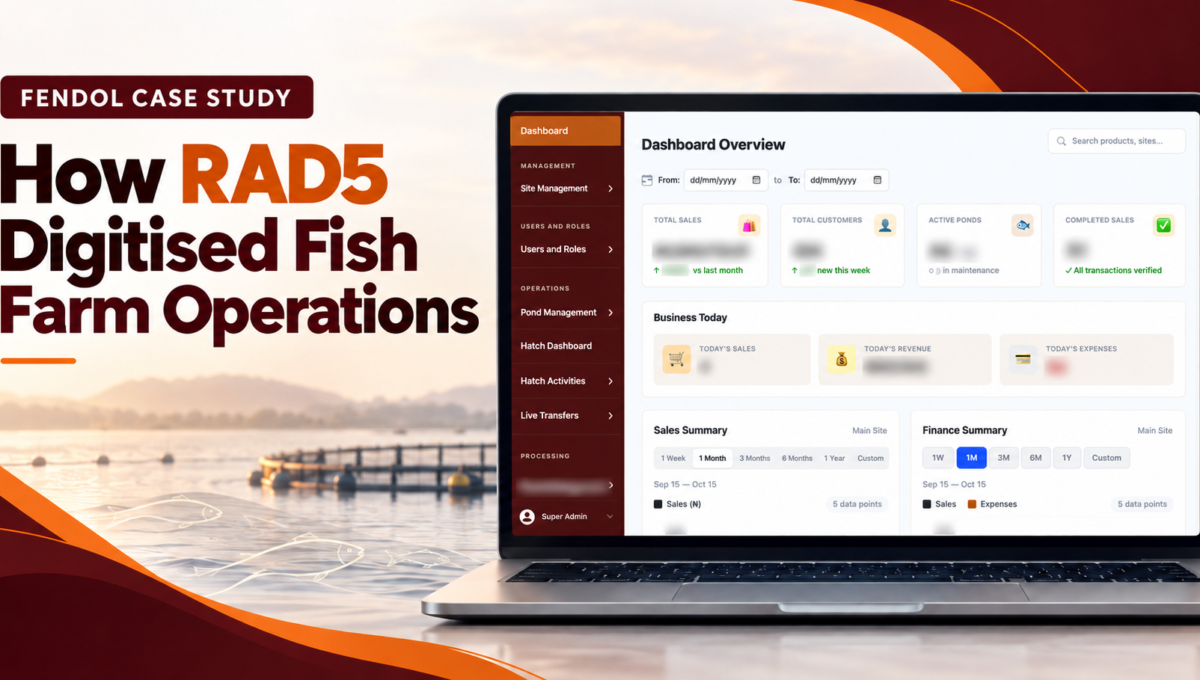
A case study of how FENDOL moved from manual, fragmented farm records to a structured system for tracking fish batches, inventory movements, processing, sales, expenses, and profitability.
Running a fish farm involves far more than counting the fish in each pond.
Fish enter the farm as fingerlings. They grow, move between ponds, get sorted, consume feed, and sometimes experience mortality. At harvest, fish from different ponds may be washed, dried, smoked, broken into different product forms, displayed for sale, and sold at different prices.
When each part of that journey is recorded in a notebook, a separate spreadsheet, or simply remembered by staff, management loses the complete story of the stock.
That was the challenge facing FENDOL, a fish farm in Aba, Abia State.
RAD5 IT Consult designed and built a custom fish farm management software solution that reflects how the farm actually operates. Instead of treating each pond as an isolated store of fish, the system follows batches as they move through production, processing, and sales.
The result is a clearer, more traceable, and more scalable way to manage the farm.
Visit the RAD5 Portfolio to see some of our work.
What is fish farm management software?
Fish farm management software is a digital system used to record, connect, and analyse activities across a fish farming operation. Depending on the farm, it can track fish batches, ponds, growth stages, feed consumption, mortality, transfers, processing, inventory, sales, expenses, and profit.
Unlike a basic accounting tool, a fish farm inventory system connects financial records to what is physically happening on the farm. This helps management answer practical questions such as:
- How many fish were purchased, transferred, processed, and sold?
- Where did stock losses occur?
- How much feed was used for a particular batch?
- What finished products came from that batch?
- Did the batch generate a profit?
For FENDOL, answering those questions required more than digitizing existing forms. It required redesigning the logic behind the farm’s records.
The problem: manual records could not show the full fish lifecycle.
Before the new system, FENDOL relied heavily on manual records and staff memory.
Fish were primarily tracked according to the ponds they occupied. That appeared reasonable at first, but it created a major gap: fish do not remain in one pond or in one condition throughout production.
As the fish grew, they moved through several stages. Some batches were transferred. Others were sorted, split, or combined. During washing, drying, and smoking, fish from multiple ponds could be mixed. By the time a finished product reached the sales point, tracing it back to its source was difficult or impossible.
This affected several areas of the business.
1. Stock figures were difficult to verify.
Management could not easily compare the number of fish purchased with the number eventually sold. Transfers and processing changed the location and form of the stock, while damage, breakage, and mortality created losses at different points.
2. Feed could not be accurately linked to batches.
Feed is an important production input. Without a reliable connection between feed usage and fish batches, the farm could not clearly see what it cost to raise a particular batch.
3. Processing broke traceability.
When fish from different ponds were combined during washing, drying, or smoking, pond-only records were no longer enough. The farm needed a way to preserve the stock’s history even after merging or processing.
4. Operational and financial records were disconnected.
Sales, expenses, and inventory were recorded separately. This created inconsistencies and made it difficult to produce dependable reports.
5. Profitability by batch was unclear
The most important question remained unanswered: Did this batch of fish actually make a profit?
The issue was not simply that the records were handwritten. The underlying tracking model did not reflect how fish actually moved through the business.
Discovery: understanding how the farm works before building software
RAD5 did not begin with screens or visual design. The first task was to understand the real operation.
The project team interviewed the farm owner and staff, mapped the production process, and examined how fish, products, and information moved from one stage to another.
The lifecycle included:
Hatchery → Nursery → Ponds → Washing → Drying → Smoking → Showcase → Sales
This discovery process revealed the project’s defining insight:
Fish are not stationary inventory. They are moving entities whose quantity, location, stage, and product form can change over time.
Tracking ponds alone would therefore never provide complete traceability. The system needed to track three connected elements:
- Batches — the identifiable groups of fish entering and moving through the farm.
- Stages — the current growth or processing state of each batch.
- Movements — every transfer, split, merge, or transformation affecting that batch.
This model became the foundation of the FENDOL system.
The solution: a stage-based inventory and operations system
RAD5 replaced the narrow idea of “pond management” with a broader product-stage inventory model.
The custom web application connects inventory, operations, finance, and reporting in one system. It mirrors the farm’s workflow rather than forcing the farm into the structure of generic inventory software.
Unique batch identification
Each batch receives a unique identity that remains useful as the fish move between ponds, pass through processing, and reach the point of sale.
This creates a traceable record of:
- where a batch originated;
- where it moved;
- what it consumed;
- the losses recorded along the way;
- what products it became; and
- how those products were sold.
Stage-based inventory
The system records stock according to its current production or processing stage, including:
- fingerlings;
- juveniles;
- mature fish; and
- processed products such as whole, broken, dried, or smoked fish.
This gives management a more accurate view than a pond count alone. It shows not only where stock is, but what state it is in.
Fish movement history
Every important movement is recorded. Staff can document transfers between stages and ponds, while management can review the history of a batch.
The system also accounts for complex but common operational events:
- Splitting: one batch is divided during grading or sorting.
- Merging: fish or processed products from multiple sources are combined.
- Transformation: live fish become one or more processed product types.
By preserving these relationships, the system maintains traceability even when operations become more complex.
Hatchery and nursery management
Dedicated hatchery and nursery modules help the farm record early-stage activities, including growth, sampling, sorting and sales made before fish reach maturity.
This extends visibility to the beginning of the lifecycle instead of starting only when fish enter a production pond.
Processing and showcase inventory
Finished products created during processing move into a showcase module where stock available for sale can be viewed and managed.
This connects production output with sales inventory. Management can see what is ready for sale and retain a record of the batches from which the finished products originated.
Sales, expenses, and finance ledgers
The system links sales and expenses to actual farm operations and stock. Instead of maintaining isolated financial records, FENDOL can connect revenue and costs to the inventory that generated them.
That connection provides a stronger basis for understanding performance and profitability.
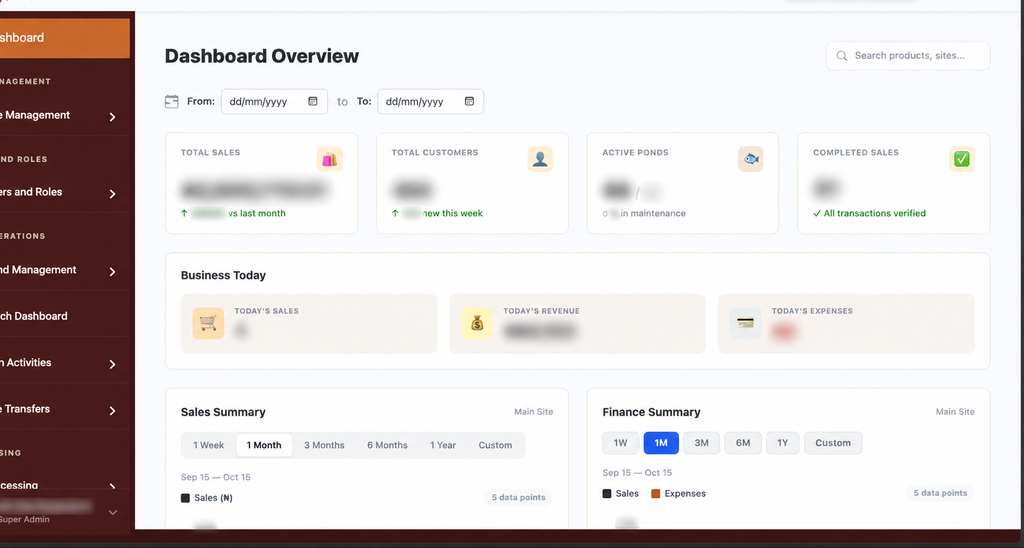
Reports dashboard
The reporting dashboard brings operational and financial information together. It helps management review:
- inventory by stage;
- recorded losses;
- sales performance;
- top-selling products;
- expenses;
- operational trends; and
- profitability information.
Reports that previously required searching through separate records can now be produced much faster.
Why custom software was the right approach
Generic inventory software usually assumes that an item enters storage, remains essentially the same, and later leaves through a sale or transfer.
Fish farm inventory behaves differently. Living stock grows, moves, and experiences mortality. It may be split or merged. Processing changes a live animal into several saleable product forms. Feed and other costs accumulate throughout that journey.
FENDOL needed software designed around those realities.
The goal was not to add unnecessary complexity or build the most decorative interface. The priority was to make the operation understandable, traceable, and faster to manage.
That is one of the main advantages of custom business software: the system can follow the company’s real workflow, terminology, approval structure, and reporting needs.
The impact: from guesswork to traceable operations
The new system gave FENDOL a connected view of the farm’s operations.
Better stock visibility
Management can see stock across production and processing stages rather than relying only on pond-level figures.
Clearer loss tracking
Mortality, damage, and breakage can be recorded at the stage where they occur. This makes it easier to investigate discrepancies and identify patterns.
Improved accountability
Recorded batch movements, sales, expenses, and operational actions create a clearer trail of responsibility for staff and management.
Faster reporting
Information that previously had to be assembled from fragmented records can be reviewed within the system, reducing reporting time from days to minutes.
More reliable business decisions
By connecting stock, operations, sales, and expenses, management has a stronger basis for evaluating performance and making data-backed decisions.
A foundation for future growth
The architecture can support future capabilities such as more advanced analytics and AI-assisted insights. The same stage-and-movement thinking can also be adapted to other farm operations, including poultry and pig production.
What RAD5 learned from the FENDOL project
The biggest lesson from this project is simple: successful digital transformation begins with the business process, not the interface.
If RAD5 had merely converted the existing pond records into digital forms, the farm would have had a newer-looking version of the same broken logic.
Instead, the team studied the full lifecycle, found where traceability disappeared, and rebuilt the information flow around batches, stages, and movements.
That approach turned the application from a record-storage tool into an operational management system.
Does your farm or business need a custom management system?
A custom system may be useful if your business:
- depends heavily on notebooks, spreadsheets, WhatsApp updates or staff memory;
- cannot reconcile physical stock with sales records;
- loses traceability when products move, merge, split or change form;
- spends days preparing management reports;
- records inventory, expenses and sales in separate places;
- cannot accurately calculate profit by batch, product, branch or project; or
- has outgrown generic software that does not match its workflow.
RAD5 IT Consult designs business systems around real operations. We study how your organisation works, identify the gaps in its process and build technology that improves visibility, accountability and decision-making.
Need a custom inventory, operations or ERP-like system for your business? Contact RAD5 IT Consult to discuss your workflow and the problem you need to solve.
Frequently asked questions
What does fish farm management software track?
It can track fish batches, ponds, growth stages, feed usage, sampling, sorting, mortality, transfers, processing, finished-product inventory, sales, expenses, and reports. The exact modules should depend on the farm’s workflow and management needs.
Can fish farm software calculate profit by batch?
Yes, if the system consistently links batch inventory and production costs to processed output and sales. Reliable profit reporting depends on accurate operational data, including feed, losses, expenses, quantities, and selling prices.
Why is batch tracking important on a fish farm?
Batch tracking preserves the history of a group of fish as it moves through the farm. It helps management connect origin, feed, transfers, losses, processing, and sales, even when batches are split or combined.
What is the difference between pond tracking and stage-based tracking?
Pond tracking shows where fish are kept. Stage-based tracking also shows their current growth or processing condition. Used together with batch and movement records, it provides a more complete picture of inventory.
Can RAD5 build fish farm management software for farms outside Aba?
RAD5 is based in Aba, Nigeria, and can design custom web-based business systems for organisations whose requirements can be properly discovered, mapped and implemented. Project scope and delivery arrangements are determined during consultation.
Can this type of system work for poultry or pig farms?
The underlying approach can be adapted to other agricultural operations. The modules, stages, costs, and reports would need to be redesigned around the real lifecycle and workflow of the specific farm.
Is custom farm software better than an off-the-shelf application?
It depends on the operation. Off-the-shelf software may be sufficient when its workflow closely matches the farm. Custom software becomes valuable when the business has specialised processes, complex stock movements, unique reporting needs, or integrations that generic tools cannot handle.
Tags
Linda Onuoha
Writer at RAD5 Tech Hub




Leave a Reply